Picture a twelve-person HVAC company. The owner is 64 and has run it for 26 years. His lead technician has been there for 15 of those years. She knows every commercial account by name, trains each new hire, and covered for him through two surgeries and a divorce.
Next year, the owner sells. What does she get?
In almost every case, a new boss. Perhaps a small bonus if the seller is generous. Nothing that reflects the 15 years she spent building the business alongside him.
What if a business sale could be an opportunity for the people who built the company, rather than a moment of uncertainty?
Working at a Small Business Shouldn’t Get You Less
Roughly one in four private-sector workers in the US work at companies with less than 50 people. If you’re in the construction industry, it’s almost one in two workers. These companies are the plumbing shops, HVAC companies, landscapers, distributors, restaurants, and service companies that make up our local economies.
Those who work in the smallest tier of those businesses, in companies with anywhere from 2 to 40 employees, earn about 19% less than those who work at comparable, slightly larger firms. They’re also less likely to have employer paid healthcare or a retirement plan with any match – or any other way that they share in the profit their work produces.
This isn’t because small business owners are stingy. The owners we’ve worked with want to pay more to their employees. The challenge is that tools that currently exist, don’t serve these small business owners and their employees.
Why the Standard tools skip these businesses
The main vehicle people bring up when they talk about employee ownership is the ESOP (Employee Stock Ownership Plan). ESOPs are good. They've created real wealth for a lot of working people. But, they can also be expensive. They also carry setup costs and annual overhead, including independent valuations, a trustee, plan administration, legal work, that run well into six figures over the life of the plan. A company with 200 employees and a few million in profit can support that cost. However, a 9-person electrical contractor clearing $400,000 in a good year can’t support it, no matter how much the owner wants to implement it.
The other tools are even further out of reach. Stock options and RSUs assume you have shares that will eventually be liquid. Employee stock purchase plans assume a public market. A 401(k) with a company stock match assumes you're big enough to have a 401(k) worth talking about.
So the ownership conversation tends to happen at a certain scale and above. The people at the small shop never get in the room — and nobody notices, because the tools that would have brought them in were never designed with them in mind.
Why this matters right now
A huge share of small businesses are owned by people in their 60s and 70s. Over the next decade, a lot of them are going to sell, hand off to a family member, or close. That's millions of businesses changing hands, with trillions of dollars, all earned by the hands of millions of workers.
In each of these transfers, ownership is getting rewritten. There is a new operating agreement, new debt structures, a new handbook – a new way of working for the people who are responsible for the past growth of the company, who don’t get a say in their future.
If a profit share or an equity stake for employees doesn't get written in at the transaction, it almost never happens later. Once the new owner is running the business and servicing the acquisition loan, the idea of carving out a piece for the team feels like a luxury they can't afford. The time to include workers is before the deal is closed.
During the ownership transition, it’s crucial to treat employee ownership as a deal term rather than a nice-to-have you'll get to eventually.
What it can look like at small scale
At New Majority Capital, we back entrepreneurs buying small businesses, mostly in that 2-to-40-employee range. We've spent a lot of time thinking about how to give the people who work at those businesses a real stake without the overhead that kills an ESOP at this size. The approach we've landed on has three pieces.
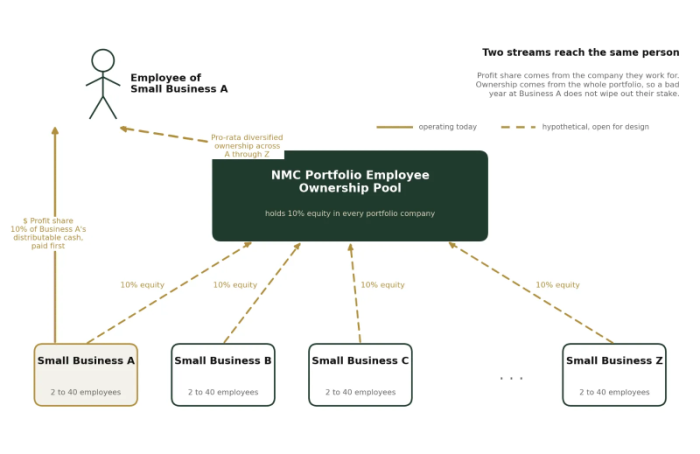
A profit share written into the operating agreement. Ten percent of each company's annual distributable cash goes to its employees, paid out before the fund or the owner-operator takes a dime. The important part is where it lives: in the company's operating agreement, and it stays there after we exit. A future buyer inherits it. That's the difference between a policy and a right.
Pooled ownership across the portfolio. We’re still working out the details on this one. But the idea is worth laying out because it addresses a problem the other tools don't. Tying a worker's ownership to one small company creates a specific risk: if that company struggles, they lose their job and their stake in the same month. The concept we're working through is that a portion of the equity we hold in each company would eventually flow into a pooled vehicle owned by employees across all of the businesses. The tech at the HVAC shop would end up with diversified exposure to a dozen companies instead of just hers, and her ownership wouldn't disappear if her particular shop had a bad year. Whether that ends up structured as a trust or something else is one of the questions we're still answering.
Pooled benefits. A 12-person company can't negotiate healthcare premiums or retirement plan fees the way a 1,200-person company can. Aggregate a couple dozen small companies and you can. The goal is that a worker at a small firm gets the same benefits floor they'd get at a much bigger one — because someone did the work to pool the buying power.
None of this requires a trustee, a valuation firm on retainer, or a plan administrator. It requires deciding, at the point of acquisition, that the employees are part of the deal.
The other half: who owns the capital
There's a version of this that stops at the employees, and that's fine. But there's a related question about who owns the funds doing the buying.
Conventional private capital is extractive by default. Money comes in from outside, buys a business, pulls out returns, and leaves. The community that produced the business doesn't see much of what it generated.
We're working on pathways for the entrepreneurs that we back to become investors in our future funds as their own businesses generate distributions. In this way, the people closing the wealth gap end up owning and governing the vehicle that helped them do it. That's a slower way to build a fund, but it's one where the capital keeps cycling back to where it came from instead of leaving.
What to actually do with this
If you're buying a small business, put employee profit share on the term sheet. It costs you very little in year one, and it changes how the team sees you before you've even walked through the door as the owner. It also tends to be the thing that gets the lead tech to stay.
If you're selling, ask your buyer what the deal looks like for your people. You'll learn a lot about who you're handing the business to. Sellers who care about legacy usually care about this more than they expected once someone raises it.
If you're a lender or investor in this space, I encourage you to consider the value that comes with providing the workforce a stronger vested interest in the business's success — even if it means the structure may be non-standard.
A quarter of the workforce has been left out of the ownership conversation because the paperwork was built for someone else. That's not a hard problem to solve. It's mostly a matter of deciding to solve it at the one moment when it's easy: the day the business changes hands.
