What a recent bETA alumni conversation taught me about how banks actually think about risk — and why the same $50,000 personal check down payment goes so much further into a business than into a home.

A few weeks ago, a recent bETA alumna reached out to catch up. She'd been talking to banks about financing her next move, and she mentioned something in passing: she found it noticeably easier to get approved for a loan to acquire a business than for a loan to buy real estate. Same person, same income, same credit profile — very different reception from the lender.
I'd always had that intuition, but I'd never actually run the numbers. So I built a model to understand this since it has implications for closing the wealth gap. Also, I admittedly love living in spreadsheets to build models.
The setup is deliberately ordinary: an entrepreneurial-minded individual earning $100,000 a year, with $63,000 in general living expenses (incl. personal taxes), $50,000 in savings sitting in the bank, ready to be deployed, and currently paying $12,000 a year in rent. These are all rough assumptions to have a starting point and to check that the inferences to be derived are going to be directionally correct.
Here's the punchline up front — all four paths start from the same $50,000. Five years later, they're nowhere near the same place:
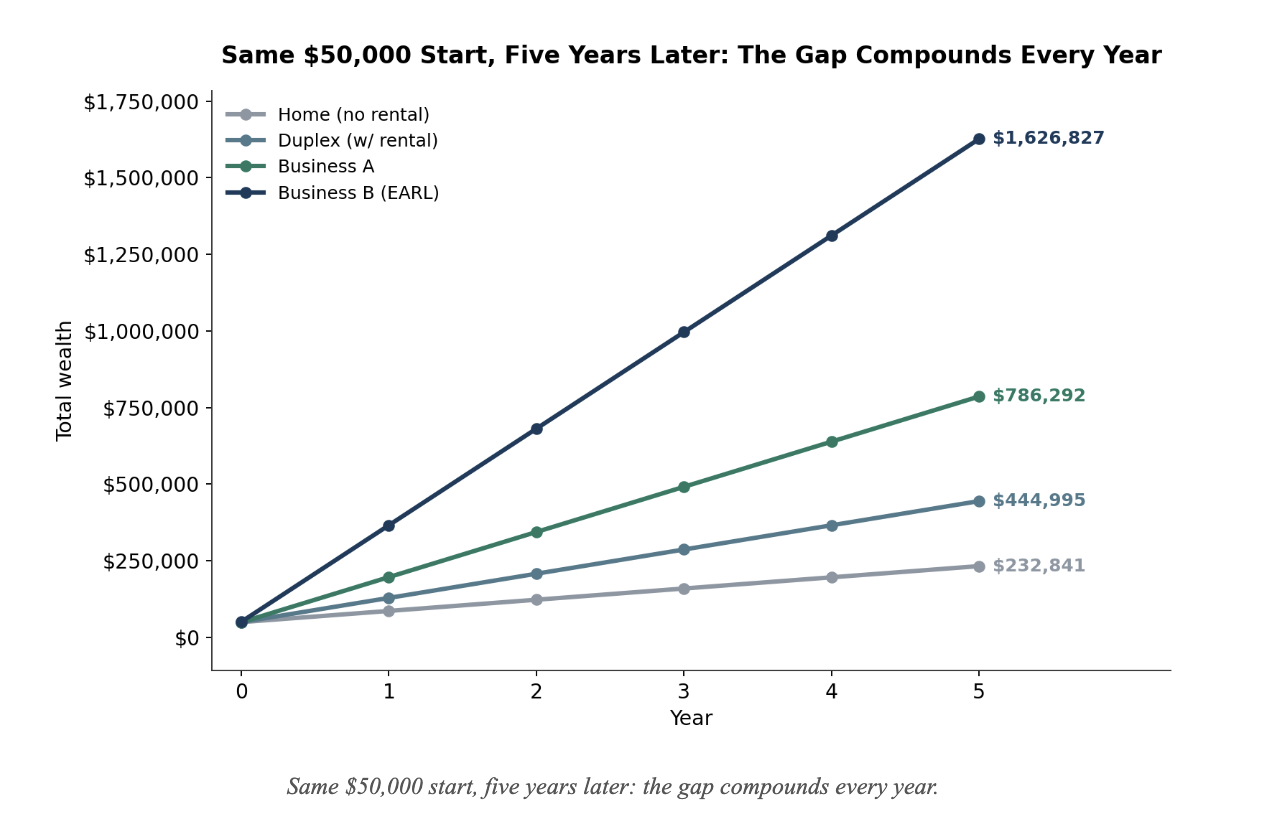
The conventional next move is a house — it's the one everyone expects, the one that feels safe because a mortgage is a familiar, well-understood product. But when you put that same $50,000 toward a small, cash-flowing business acquisition instead, the five-year outcome isn't just a little better. It's not even close. The individual is way better off owning a cash-flow-generating asset (a business they run) plus a house, if they choose to.
This is not to say owning an asset like real estate is important to close the wealth gap. At NMC, we view asset ownership broadly to include business ownership as a means to close the wealth gap, especially for entrepreneurial-minded individuals, pursuing entrepreneurship through acquisition, which is not for everyone.
The starting point
Before comparing anything, it's worth being honest about what this person's cash flow actually looks like — because that number, not the salary, is what a lender underwrites against.
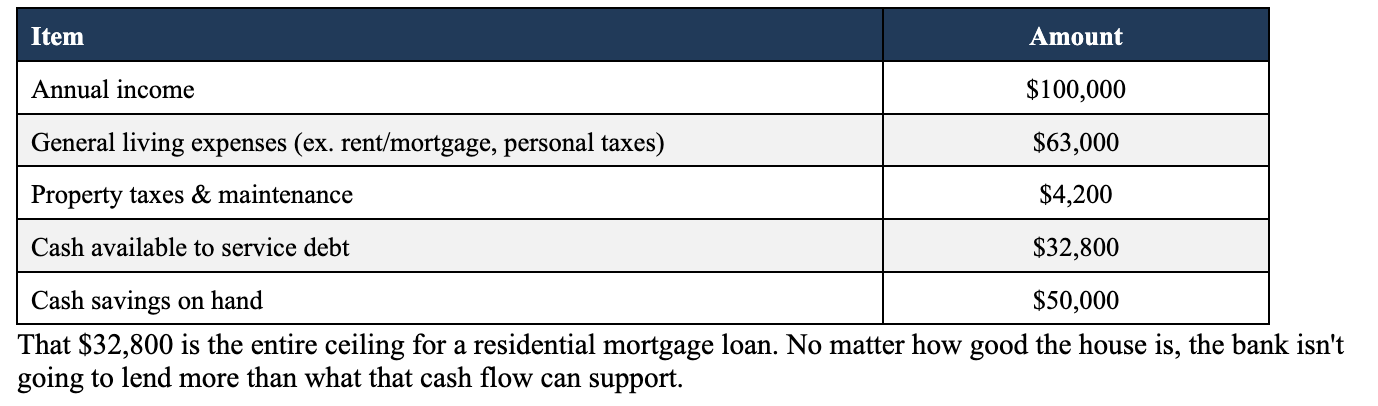
Scenario 1: buy a house
With $50,000 as a 10% down payment, this buyer can afford a $500,000 home, financed with a $450,000 mortgage at 6%. That's already a stretch in a lot of metro areas in terms of whether one can find a home to live in at that price.
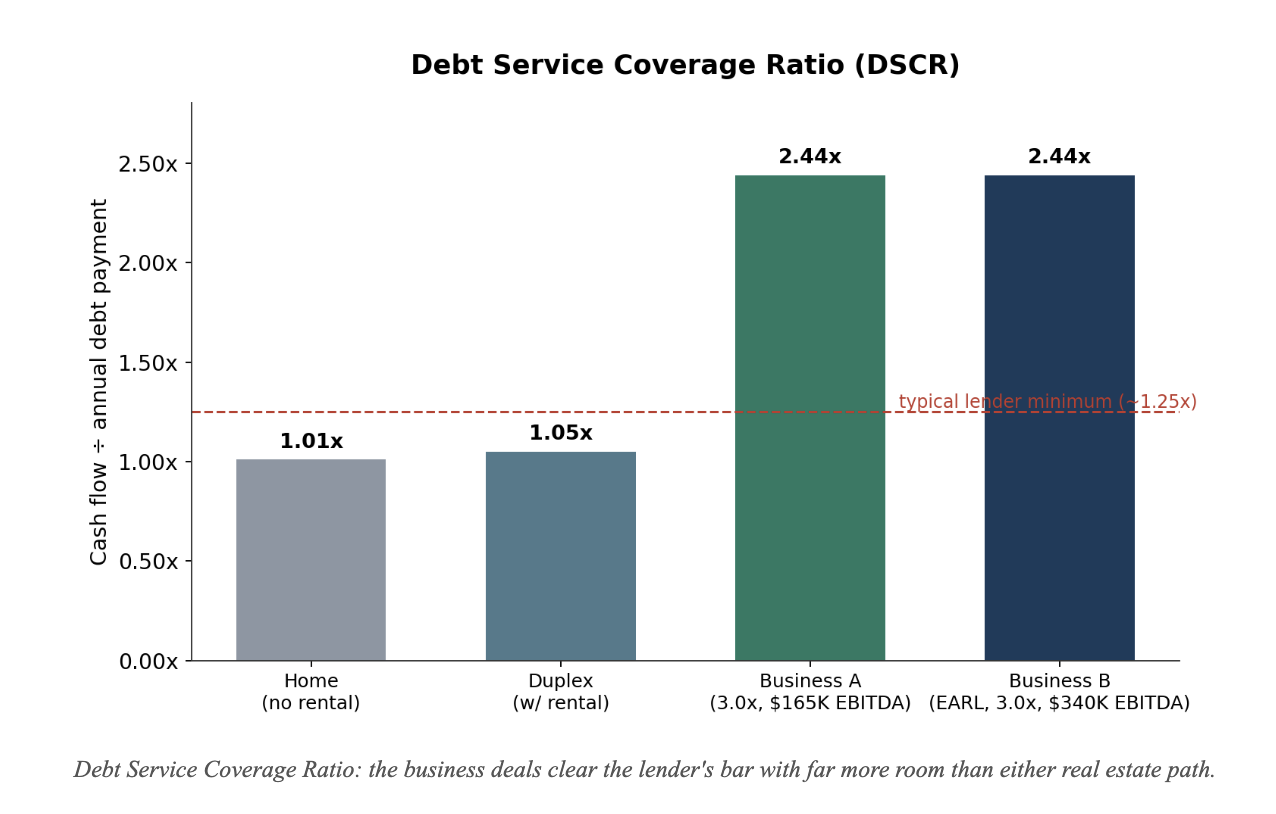
The annual mortgage payment comes to about $32,376, against $32,800 of available cash — a debt service coverage ratio (DSCR) of just 1.01x. That's not a comfortable approval; it's barely break-even, and probably well below the thresholds most lenders actually want to see. In practice, a deal this tight often gets declined outright, or approved only at a smaller loan amount. Even including the modest tax benefit from mortgage interest deductibility ($2,265), leftover cash after the mortgage is only about $2,689 a year — a razor-thin cushion for a $450,000 obligation.
This scenario playing out also is highly dependent on the individual maintaining that job with that salary, which is not guaranteed and ideally the individual has a rainy day/emergency fund, which may not exist if they are putting all their savings into the down payment.
Scenario 2: buy a duplex instead (rental income helps, but not enough)
What if the real estate is itself income-producing — say, a duplex where a rental unit brings in $48,000 a year? That changes the picture meaningfully: total income effectively becomes $148,000, and cash available to service debt jumps to $71,680 once the higher property taxes, maintenance, and living costs that come with a larger property are backed out.
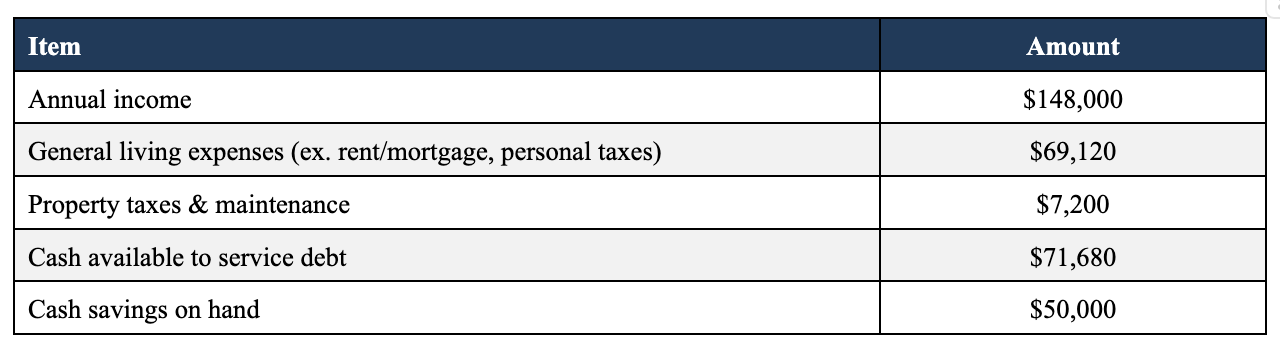
With a smaller 5% down payment, that supports a $1,000,000 property, financed with a $950,000 mortgage at 6%. Annual mortgage servicing comes to about $68,349 — a DSCR of 1.05x, still below the typical lender minimum, but for the purpose of our analysis, let's assume this gets approved. Even with a tenant helping carry the note and a larger mortgage-interest tax benefit ($7,215), leftover cash after debt service is only about $10,546 a year.
The rental income clearly helps — it roughly quadruples the leftover cash versus the plain mortgage — but it doesn't fix the underlying problem. Both real estate paths, one with a tenant and one without, land below the coverage ratio most banks require. This is the crux of it: real estate financing is capped by personal (and rental) income, and at this income and savings level, that cap sits below where lenders actually want to see a deal.
Similar to the above scenario, this scenario playing out is also dependent on the individual maintaining that job with that salary so they can service their portion of the mortgage payment, and ideally the individual has a rainy day/emergency fund.
Scenario 3: buy a business instead
Now point the same $50,000 at a small business acquisition. Businesses are priced as a multiple of adjusted EBITDA (seller's discretionary earnings, net of a new owner's salary) and typically financed with 10% down or less through SBA-backed loans (which can include a working capital or line of credit at time of closing) — sometimes with a minimum of 5% down when the balance is covered by a seller note held on standby for the life of the loan, or through grant-like programs like EARL available to bETA alum or this 5% could be covered by an investor if (as per the latest SBA SOP which goes into effect on October 1 2026) the investor is ok not receiving any distributions till the SBA loan is paid off.. That leverage structure simply isn't available to a residential home buyer.
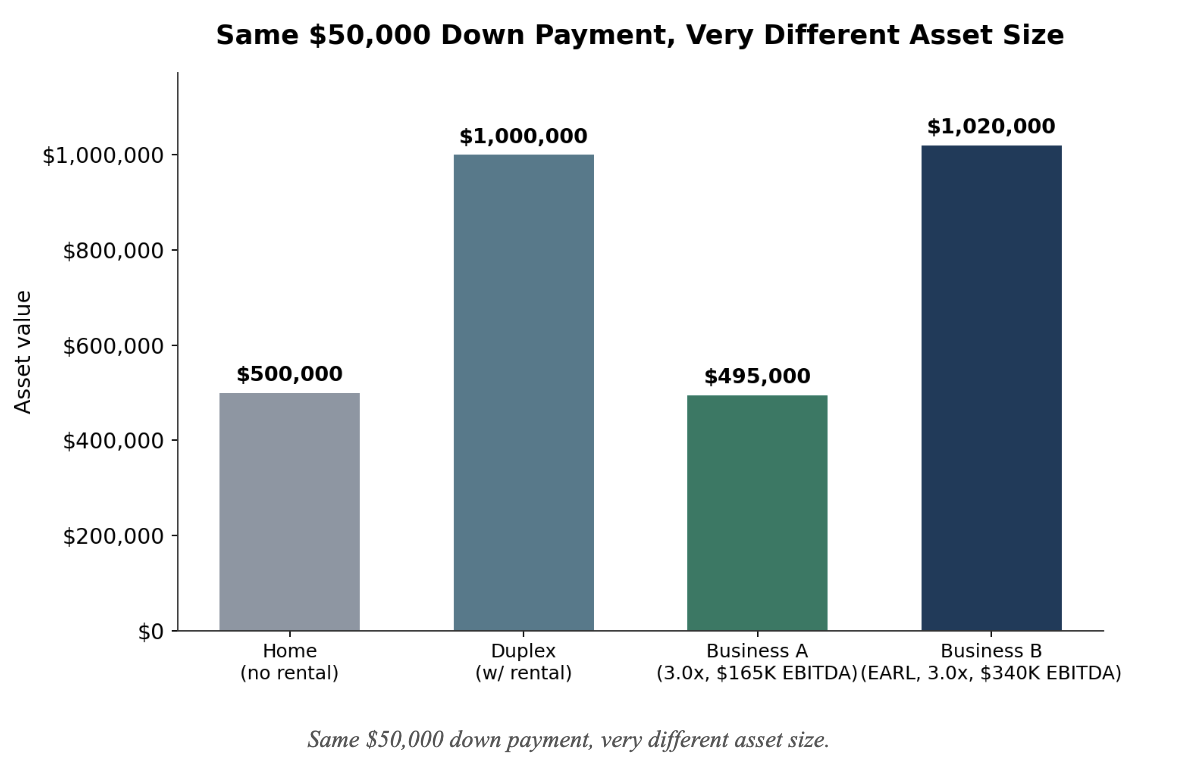
Business A — a $165,000 EBITDA business at a 3.0x multiple ($495,000 total value, after closing costs), 10% down:
-
Down payment: $49,500 (covered by savings)
-
Business loan: $445,500 at 9%
-
Annual loan payment: $67,721
-
DSCR: 2.44x — more than double the coverage cushion of either real estate path, and way higher than the 1.5 DSCR that most banks want to see.
-
Gross excess cash after debt service: $97,279/year
-
Net of this buyer's own $12,000/year rent (they don't yet own real estate), assuming a 15% tax rate: $85,279 a year.
Business B — a larger $340,000 EBITDA business at a 3.0x multiple ($1,020,000 total value), using a seller note on standby for 10 years or EARL-type structure to bring the down payment to 5%:
-
Down payment: $51,000 (covered by savings)
-
Business loan: $918,000 at 9%
-
Annual loan payment: $139,546
-
DSCR: 2.44x
-
Gross excess cash after debt service: $200,454/year
-
Net of $12,000/year rent and $11,410/year set aside to pay off the seller note / EARL balance, assuming a 15% tax rate: $177,044 a year.
Even after conservatively deducting this buyer's ongoing rent — and, in Business B's case, money set aside to retire the seller-note/EARL balance — both business paths leave dramatically more cash on the table than either real estate path. The same $50,000 that maxes out at a $500,000 house — or a $1,000,000 duplex with a tenant helping carry it — controls a business worth up to $1,020,000, with far more cash flow attached to it.
Why the bank says yes faster to the business loan
This is the part that surprised the bETA alum, and it's the mechanism behind everything else in this post: it's often easier to get approved for a $445,500 or $918,000 business loan than for a $450,000 home mortgage — even though the business loans are comparable or larger in size and carry a higher rate.
A residential mortgage is underwritten against the borrower's personal income. The bank takes your salary (plus rental income, if any), nets out living costs, and sizes the loan around what's left. There's a hard ceiling on how much house that income can support, no matter how good the property is — and at this income level, that ceiling sits right at the edge of what's fundable at all.
A business acquisition loan — especially one backed by the SBA — is underwritten against the cash flow of the business itself. The lender isn't betting on your paycheck; it's betting on the business's own EBITDA covering the note, with your salary from the new business sitting untouched in the background as a secondary cushion. Lenders also typically want to see a few months of loan payments held in reserve ($16,930 for Business A, $34,887 for Business B) — something that bETA's EARL program can also support. As long as the DSCR clears the lender's minimum (commonly ~1.25-1.50x) and the buyer has cash in the bank, a decent credit score, and a stable work history, the bank can get comfortable with a loan many multiples larger than anything that same buyer would qualify for on a personal mortgage.
The excess cash flow gap
None of this matters unless it shows up as money left in your pocket every year from a wealth creation potential, and this is where the comparison becomes lopsided.
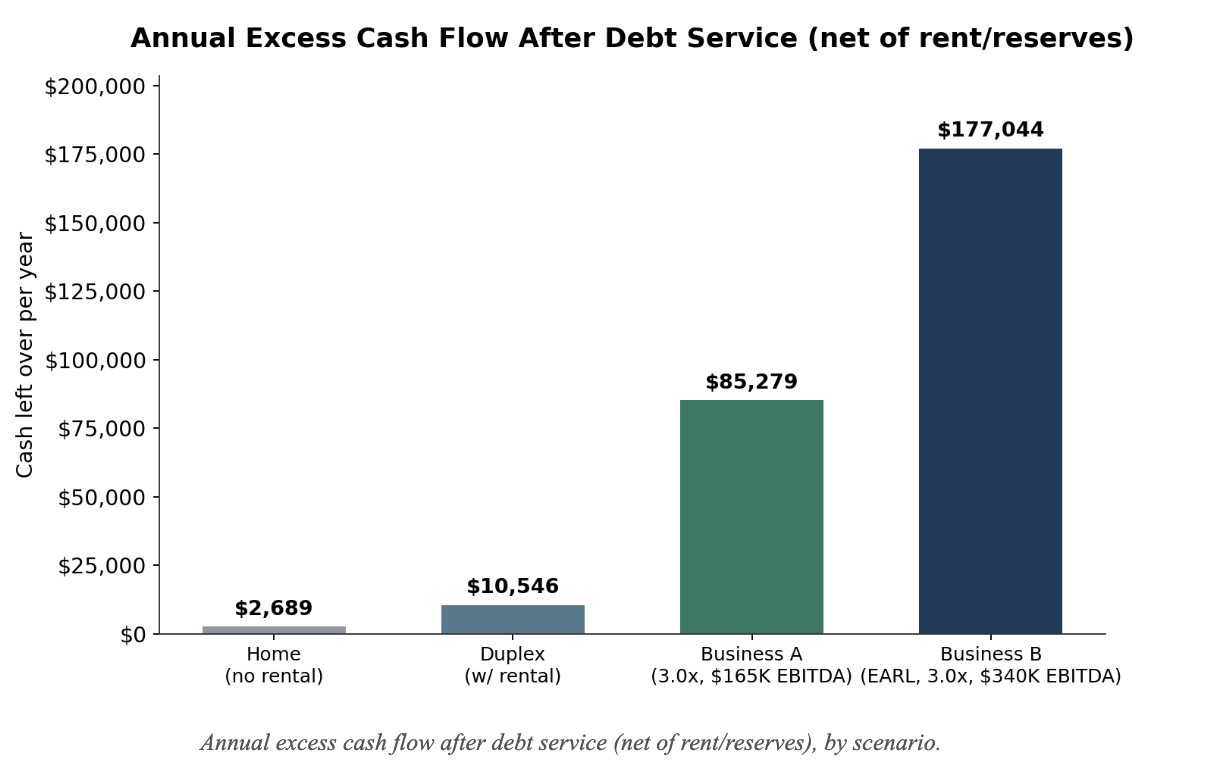
The plain mortgage leaves $2,689 a year. The duplex, with a tenant helping, leaves $10,546. Business A leaves $85,279 — roughly 32 times more than the plain mortgage and 8 times more than the duplex — even after this buyer's own rent is deducted. Business B leaves $177,044 a year, even after setting aside money to retire the seller note. That gap compounds every single year the asset is held.
The five-year picture
Extend all four paths five years forward — accumulating the annual excess cash flow, and growing each asset's value at a conservative 5% a year, net of the remaining debt owed against it — and the gap compounds into something structural, not incidental.
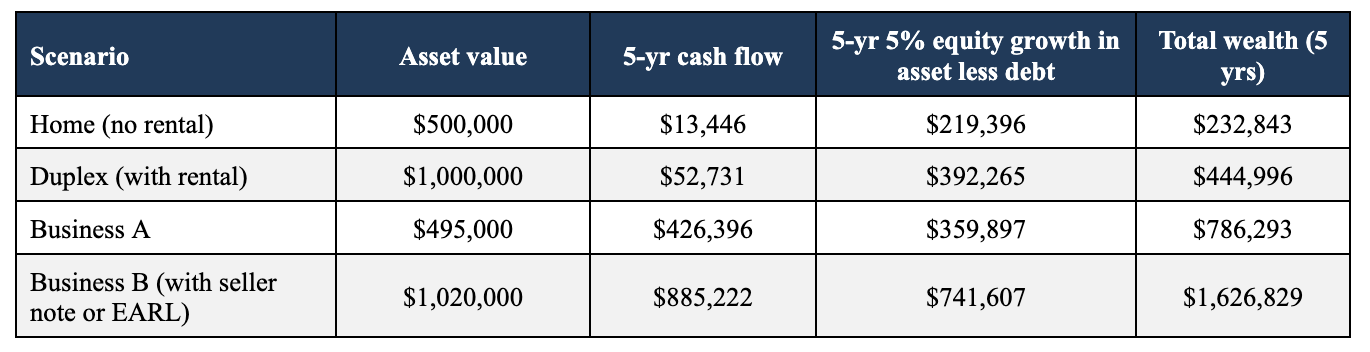
The plain house turns $50,000 into $232,843 over five years — a decent outcome, and one that assumes the loan gets approved at all given its thin coverage ratio. The duplex, thanks to rental income, roughly doubles that to $444,996 — still below what even the smaller business produces. All this assumes that you still remain employed at the minimum of $100k per year. On the other hand, Business A reaches $786,293 — more than three times the plain house. Business B reaches $1,626,829 — nearly seven times the plain house, and more than triple the duplex.
The move you actually unlock: sequencing, not either/or
Here's the part that gets missed when people frame this as “business or real estate” — it isn't a fork in the road, it's a sequence. Buy the business first, and by year two you're not choosing between owning a business and owning a home. You already have the business's own cash flow doing the work, and you can use two years of accumulated excess cash as the down payment on real estate — home or duplex — without ever touching your original $50,000 twice.
I modeled exactly that: acquire the business in year one, then in year two, use $50,000 of the business's own accumulated cash flow as a down payment on a house (or a rental duplex), and run both assets forward to year five.
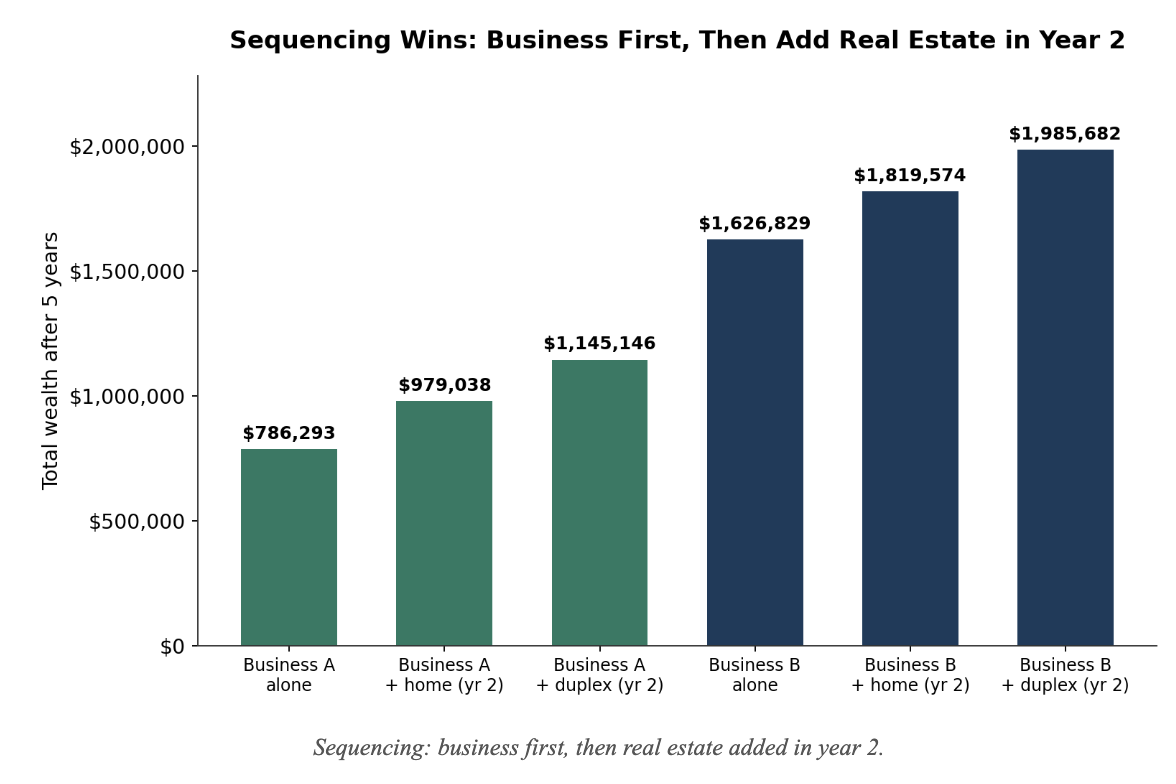
Business A alone reaches $786,293 in five years. Add a home in year two, funded by the business's own cash flow, and total wealth rises to $979,038. Add a rental duplex instead, and it reaches $1,145,146. Business B alone reaches $1,626,829; paired with a home in year two it's $1,819,574, and paired with a rental duplex it's $1,985,682 — more than eight times what the house-first path alone would have produced, while still ending up owning real estate.
That's the actual argument: the business doesn't just outperform the house as a standalone investment — it funds the house, with room to spare, while a house-first path leaves you exactly where you started: one home, a thin cash cushion (or in this case, a loan that may not have cleared underwriting at all), still locked in a job, and no separate capital pool to go acquire anything else with.
Where this argument needs strong caveats
None of this makes owning a business risk-free or effortless, and it's worth being direct about what the model doesn't capture. A house — even a duplex with a tenant — is a largely passive asset once the mortgage is signed. A business is not passive at all: acquiring Business A or B means taking on real operating responsibility — managing employees, customers, and cash flow through good years and bad ones, or paying for management to do it, which cuts into the excess cash flow used in this model. Most business acquisitions experience a J-curve in year 1 after the acquisition that has to be taken into account. There also needs to be a good fit between the buyer and the business.
EBITDA multiples vary widely by industry, seller notes, EARL-style structures are not always available, lender, and deal quality matters; actual SBA underwriting is more involved than a single DSCR number (customer concentration, dependency on the owner, project based vs recurring revenue, need for cash to be re-invested in the business etc.), SBA rules may change over time and typically the SBA or the banks may require a higher post acquisition personal reserve at the time of the acquisition; and a business's cash flow can be far more volatile year to year than a mortgage payment or rental check. This comparison assumes a clean acquisition of a healthy, well-run business (or a well-tenanted rental property) at reasonable terms — which takes real search time, diligence, and some operating skill to find and execute, which programs like bETA aim to deliver.
Still, even with those caveats built in, the underlying mechanism holds: banks lend against cash flow far more generously than they lend against personal income. At this income and savings level, the real estate paths don't just underperform — they may not clear the bank's own bar for approval. A $50,000 personal check goes dramatically further, and stands a much better chance of getting funded at all, when it's used to control a cash-producing business rather than a personal residence, leading to a higher wealth creation effect. The conclusion supported by this analysis is: Buy the business first. The house comes easier after.
_______________________________________________
Figures throughout are based on a financial model (income, savings, EBITDA multiples, loan terms, and 5-year growth assumptions as supplied). Actual loan terms, multiples, and DSCR minimums vary by lender, industry, and deal. This is not meant to be financial or tax advice and may not have captured all the variables and risks correctly involved in a decision like this.
